
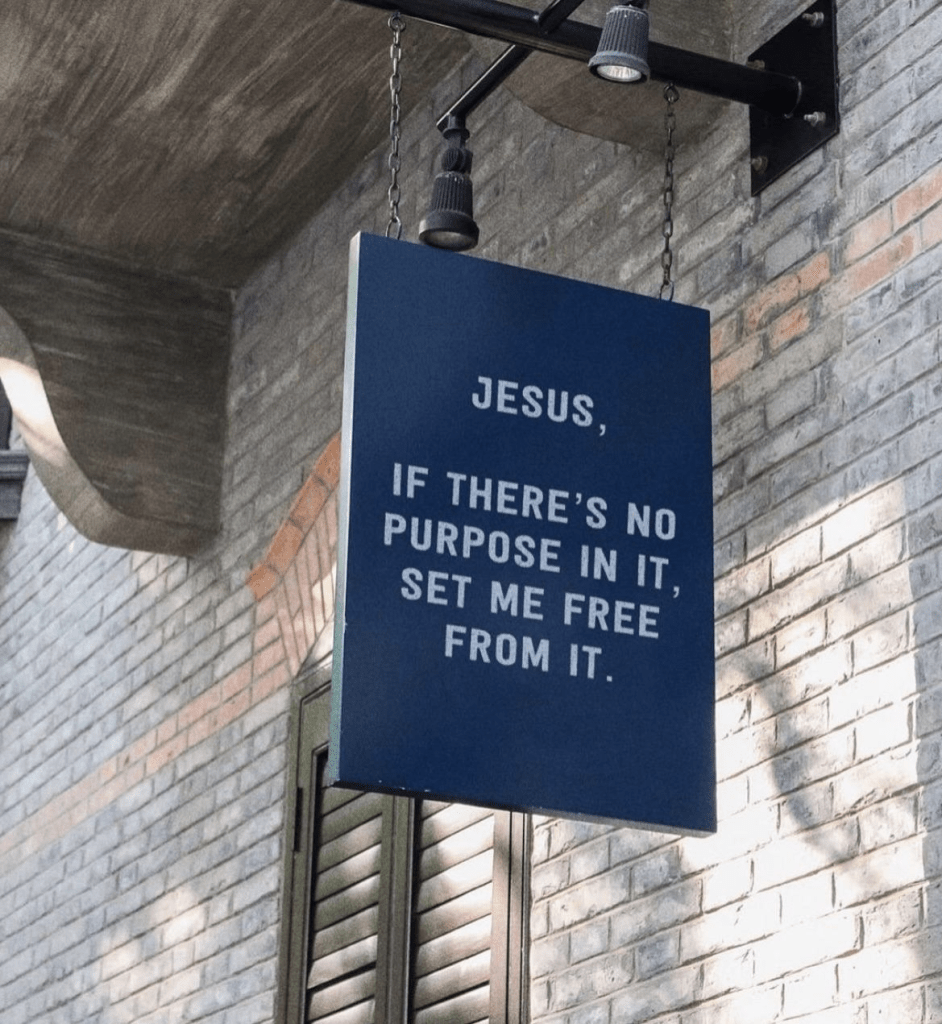
Sometimes we hold onto things—not because they fulfill us, or align with our purpose—but simply because they feel familiar. Familiarity creates an illusion of safety. Whether it’s a relationship, a job, a routine, or even a belief system, we often cling to what’s known because the unknown feels risky. The irony is that what once brought comfort can slowly become a prison if it prevents us from stepping into the unknown where real growth happens.
I was talking to a guy that I thought was the one. He was gentle. He was kind. He was thoughtful. He made me laugh. Conversations were easy. The connection felt real. It felt safe. And for a while, I didn’t see a reason to let go. But deep down, I knew I wasn’t holding onto him because it was God-ordained. I was holding on because it was comfortable. There’s a big difference. Comfort is not always confirmation. Sometimes comfort is just familiarity— and familiarity can lead to complacency if you’re not careful. I wanted to stay where I was because it felt easy, but God was tugging at my heart. I knew this wasn’t in alignment with what He had for me. I knew this wasn’t my destiny. I knew that if i stayed, I would be settling for good when God was calling me to great. Not saying that this person I was talking to was bad, but he couldn’t lead, push, or take me where I needed to go spiritually in the season I’m in.
Abraham faced this same crossroad in Genesis 12. God told him, “leave your native country, your relatives, and your father’s family, and go to the land that I will show you.” Abraham could’ve chosen comfort—staying in what he knew. But instead, he chose calling. The rich young ruler in Mark 10 wasn’t so willing. Jesus told him to let go of his wealth and follow him. But scripture says the man went away sad because he had great possessions. He didn’t want to leave comfort behind, so he left the greater blessing on the table. The Israelites, God miraculously delivered them from slavery in Egypt, yet shortly after their freedom, they began to complain. In Exodus 16:3, they said, “We had meat and bread in Egypt! Why did you bring us out here to die in the desert?” They longed for the comfort of what they once knew—even if it meant returning to bondage. Their complacency made them forget that God was leading them to a land of promise, not punishment. But the wilderness was uncomfortable, unfamiliar, and required faith. Sound familiar? Then there’s Lot’s wife in Genesis 19. God was mercifully rescuing her and her family from a place of destruction, but she couldn’t help but look back. The Bible says she turned into a pillar of salt—not because of a glance, but because her heart was still tied to what she was leaving. She didn’t want to let go of the life she’d built, even though staying would have destroyed her. Comfort clouded her discernment. She preferred the known chaos over the unknown plan of God. Jonah’s story adds another layer. When God called him to go to Nineveh, he ran in the complete opposite direction. Jonah was comfortable with his assumptions and biases. Nineveh didn’t deserve God’s mercy, in his opinion. But God wasn’t just calling him to a city— He was calling him out of his complacency. Obedience would mean facing discomfort: emotionally, culturally, and spiritually. And yet, it was in Jonah’s eventual obedience that an entire city was saved. BUT it took Jonah traveling 2,500 miles the opposite way, getting put in the belly of a whale, and repenting. He acknowledged his disobedience, confessed his sin, and cried out to God for forgiveness and deliverance. During the days he was in the belly God led the whale right back to Nineveh for Jonah to do what God called him to.
Each of these examples shows us something critical: God often calls us away from comfort because He’s calling us into growth. Into transformation. Into purpose. And while it may be easier to stay in what’s familiar, staying too long can lead to spiritual stagnation. That’s the danger of complacency—it convinces you that “good enough” is good enough. So here’s the question we all need to ask: What am I holding onto simply because it’s comfortable? A job? A relationship? A version of yourself that no longer fits who God is shaping you to be? The truth is, God will never ask you to let go of something without the intention of giving you something better. But you won’t see it if your hands—and heart—are still full of the old.
And I get it. Because letting go of something good hurts when you don’t fully see what’s ahead. I wasn’t letting go of a bad person. He was good. He was kind. He was fun. But he wasn’t God’s best for me, and if I would’ve stayed in that moment, I would’ve been choosing complacency over calling. Isaiah 43:19 says, “For I am about to do something new. See, I have already begun! Do you not see it? I will make a pathway through the wilderness. I will create rivers in the dry wasteland.” It reminds us that God is always at work— renewing, restoring, and reshaping our lives in ways we often don’t expect. Maybe it’s a season of your life that served its purpose, but you’re afraid to move on. Or maybe it’s a role, identity, or dream that no longer aligns with who God is calling you to be. Whatever it is, holding on to what no longer fits can keep you stuck—spiritually, emotionally, and even physically.
Comfort is not the same as peace. Comfort feeds the flesh. It’s about what feels familiar and safe— even if it’s no longer healthy. But peace? Peace is rooted in the Spirit. Peace doesn’t always make sense on paper, but it settles deep in your soul. And when God is shifting something in your life, you’ll feel it. You may not have all the details, but you’ll know: this isn’t aligned anymore. It takes courage to listen to that inner knowing. It takes faith to act on it—especially when your heart isn’t ready to let go. But hear this: God never asks you to release something just to leave you empty. He asks you to release it to make space for what’s next. For what’s better. For what’s yours. Yes, the unknown is scary. Letting go can hurt. But staying stuck in a place you’ve outgrown can cost you more than you realize. It’s better to let go now than to settle later. It’s better to trust God now than to miss out on the “new thing” He’s already begun. So if your spirit is stirring… if something feels off even though everything looks “fine” on the outside… lean in. Ask God what He’s saying. And if He’s asking you to release something, trust that He’s already making a way in the wilderness. He’s already creating rivers in dry places. You won’t be left with nothing. You’ll be positioned for everything He has next.
 originally victoria — unfiltered blog
Leave a comment